Audien review: What the evidence can and cannot prove before checkout
Audien has a documented order page, but the supplied evidence does not independently verify the seller’s regulatory wording, finished-product performance, intended-user boundaries or complete purchase terms. This review identifies what remains to be checked.
8,226+
Videos & Ads
+50-100
Fresh Daily
$29.90
Per Month
Full Access
12.5 TB database · 72+ niches · 27 min read
Audien is not supported by enough product-specific evidence for a broad recommendation. The supplied record supports a narrower conclusion: it is an offer that requires careful inspection before payment.
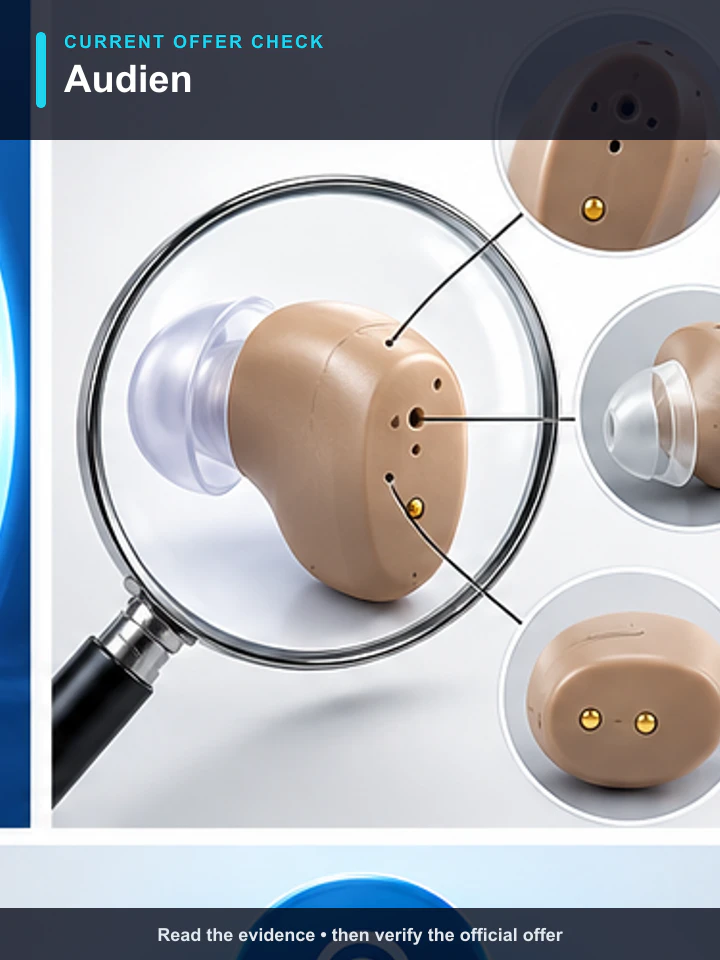
The official source identifies an Audien order page. Its captured text includes “1X ATOM ONE HEARING AID.” Audien Hearing also calls the product an “FDA Registered Device” and says it uses hearing-aid technology “cleared for OTC use.” OTC means over the counter and, in this context, describes a route outside the conventional prescription path.
Those regulatory statements belong to the seller. The packet does not include the underlying FDA device record, an exact identifier tied to the wording or independent documentation establishing what the claimed registration or clearance covers. It also contains no Audien-specific clinical trial or comparative performance test.
The commercial record has similar limits. Captured page fragments showed several product prices, discount messages, optional-service controls and checkout fields. They also contained unresolved monetary placeholders and savings figures that conflict with straightforward subtraction. The evidence does not establish the final price for a defined configuration, shipping cost, delivery schedule, return process, refund eligibility, support procedure or whether every possible charge is one-time.
This is not evidence that Audien fails. It is evidence that the packet cannot establish whether the product fits a particular person or will produce a dependable outcome.
Audien may remain a candidate for a reader who can identify the exact device, confirm its intended use and safety information, inspect the full payment terms and accept the lack of finished-product proof. It is a weaker candidate for someone who needs an individualized hearing assessment, Audien-specific performance evidence or fully documented consumer protections.
Our assessment would become more favorable if independently checkable device records, exact technical and intended-use information, suitable Audien-specific testing and coherent customer terms were supplied. Unresolved placeholders, unexplained add-ons or regulatory wording that cannot be connected to the device being sold would move it in the other direction.
Decision snapshot
- Exact product: Audien by Audien Hearing
- Current offer check: Verify the current selection, complete checkout total, renewal status, shipping, and exit terms before paying.
- Evidence boundary: Official sources establish identity, label, offer and manufacturer-attributed claims; they do not establish efficacy.
- Before deciding: FDA does not approve dietary supplements for safety and effectiveness before they are sold. Supplements can interact with medicines and consumers should discuss use with a health professional and report adverse events.
This Audien review focuses on the exact product, the current offer, the evidence boundary, and the conditions that should change the decision.

The decision Audien still needs to earn
Decision: The useful question is not whether the order page sounds reassuring. It is whether the documented device matches the task a reader expects it to perform.
A phrase such as “hear better” is too broad to settle that question. A careful buyer should first describe the setting in which help is wanted, how often the problem occurs, its practical effect and what remains uncertain. That exercise is not a diagnosis. It helps distinguish a product-selection problem from a hearing-health question that may require qualified professional guidance.
The packet supports three firm findings.
First, Audien is a documented commercial subject. The captured official page was titled “Audien | Order” and was attributed to Audien Hearing. A reachable storefront establishes identity and a captured sales path. It does not establish suitability, performance, fulfillment quality or a customer outcome.
Second, the FDA-related and OTC wording remains a manufacturer claim. The packet verifies the words on the seller-controlled page but does not supply the independent record needed to determine the exact device, regulatory basis, intended use or limitations covered by those words.
Third, the only supplied study is about hearing-aid use as a category. It is not a study of Audien. Category research can explain what researchers have examined, but it cannot be converted into an Audien benefit claim.
A reader who continues should treat the live offer as a verification exercise. The important questions are specific: What exact model is selected? What is included? Who is it intended for? What warnings or exclusions apply? What setup is required? What is the complete charge? Are optional services selected? What happens if the device is unsuitable?
The answer cannot come from a headline alone. It requires a defensible connection among the exact device, the reader’s need and the complete financial commitment.

What the Audien Hearing page actually establishes
Product identity: The official Audien order page establishes a storefront path and seller-controlled product presentation. The capture includes the text “1X ATOM ONE HEARING AID,” several product images and multiple promotional price elements.
That does not establish a complete product catalog. No structured product record was recovered. The packet does not reliably identify which version was selected by default, whether every displayed amount concerned Atom One, what accessories accompanied each choice or how the displayed choices differed.
This distinction matters. The editorial subject is the Audien brand offer, while the transaction concerns one selected device, quantity and set of options. Brand identity cannot substitute for checkout-level specificity.
The page fragments displayed messages stating that a 50% discount and an extra 10% discount had been applied. Other fragments showed savings percentages of 26%, 37%, 46% and 48%. The capture did not reliably reconstruct the selection state or the calculation behind each promotion.
The page also contained first-name, last-name, address, telephone, shipping and billing fields. It warned returning customers to review a previous order to avoid placing a duplicate. That shows a direct order flow. It does not reveal which payment methods were available, when a charge would occur or what post-purchase process followed submission.
A lifetime-protection prompt appeared with language describing protection and replacement coverage. Its extracted price was “$xxx.” The page also showed a SafeTrak on/off control and nearby delivery language. The evidence does not establish whether either option was selected, what it cost, what contractual coverage applied or whether its terms imposed any later obligation.
Order-summary fragments included placeholders such as “$xx.xx” and “$xxx” for items including donation, shipping, tax, warranty and total. The page stated that pricing was in United States dollars. It did not provide a completed order summary in the packet.
The capture also recorded a canonical URL ending in “/en/undefined.” That is a captured metadata anomaly. It is not treated here as another product page or a usable commercial destination. It is one more reason to verify the actual route and checkout state rather than infer them from page metadata.
The defensible product-level conclusion is therefore limited. Audien Hearing had a captured order page containing a hearing-aid product label and sales controls. The exact package and its governing terms were not fully established.
From first click to an active order: where the evidence stops
Decision path: For an Audien decision, follow the evidence in buyer order: eligibility and intended use, first click, product selection, signup or contact details, payment, delivery, support, renewal and cancellation. The packet does not establish every stage.
Evidence boundary: The buying journey begins with the publisher link, but the packet says the tracking redirect was deliberately not opened. The commercial record identifies an intended Audien order destination, yet it does not prove how the affiliate redirect currently behaves. The commercial action in this package must therefore be understood as an opportunity to inspect a live offer, not a verified promise about its redirect, destination or terms.
After arrival comes product selection. Several amounts and images appeared in the capture, but their relationship to model, quantity, accessories and selected state was not reliably recovered. A buyer would need to confirm each of those elements before entering payment information.
Optional services form a separate decision. The lifetime-protection prompt and SafeTrak control appeared alongside the base purchase flow. The packet does not establish their complete prices, default states, coverage limits, exclusions, claims procedures or cancellation conditions. The fact that a control can be switched on or off does not establish whether it is free, recurring or governed by a separate agreement.
The page then requests personal, shipping and billing information. The capture does not establish accepted payment methods, authorization timing or the sequence after order submission. It contains no completed transaction evidence.
The final-total stage is especially uncertain. The extracted order summary retained placeholders for shipping, tax, warranty and total in some locations. No source in the packet shows a finalized cart containing one identified device and all applicable charges.
The remaining journey cannot be reconstructed. The packet supplies no verified policy setting out dispatch timing, delivery estimates, setup assistance, customer-support channels, return eligibility, a return deadline, required product condition, return-shipping responsibility, restocking charges, refund processing or cancellation instructions.
These omissions should not be resolved by assuming standard ecommerce practices. A term common elsewhere may not apply to this order.
A buyer who reaches checkout should retain the exact product description, selected options, total and governing terms shown before payment. That record would document the actual transaction if the live state differs from the October 2026 capture.
The sequence can be summarized without filling the gaps:
- Confirm that the redirect reaches the expected Audien destination.
- Identify the exact model, quantity and included items.
- Review every selected protection, delivery or other optional service.
- Inspect the complete price, shipping, tax and future-charge language.
- Read the support, return, refund and cancellation conditions.
- Submit payment only if the device information and full commitment are acceptable.
The packet documents parts of the first four stages. It does not document a successful order, delivery, use, return or refund.
What Audien Hearing claims and what would verify it
Evidence boundary: Audien Hearing presents the product as an “FDA Registered Device” using “Real hearing aid technology cleared for OTC use.” The packet establishes that this wording appeared on the official source. It does not independently confirm the wording’s legal or technical scope.
claim versus evidence boundary: The seller-controlled page records what Audien Hearing said. It does not independently establish the device status, scope, suitability or outcome.
A proper verification would need to answer several questions:
- What exact device name or identifier is covered?
- What regulator record supports the registration wording?
- What record, classification or rule supports the OTC statement?
- What intended use and population apply?
- What warnings, limitations or exclusions accompany the status?
- Is the device in the current cart the same product covered by the record?
The supplied material answers none of those questions. General knowledge about FDA terminology cannot be used to complete the missing record.
The official page also contains the FAQ wording, “Will this really help me hear again?” That is a question posed by the seller, not evidence of a result. A product-specific answer would require a clearly identified Audien version, an appropriate participant population, a comparison condition, measured hearing outcomes, a use period, fitting details and reported limitations.
No Audien-specific clinical trial appears in the packet. No independent comparative test or bench measurement is provided. There is no verified report of amplification characteristics, durability, comfort or real-world effectiveness for the offered configuration.
Safety information is similarly incomplete. The packet contains no Audien manual, complete device label, warning list, contraindication list or adverse-event analysis. It also does not establish interactions or compatibility issues involving medicines, other devices, procedures or individual conditions. That absence cannot be turned into a claim that no interaction or compatibility concern exists.
The correct treatment of each claim is attribution. Audien Hearing used the regulatory and technology language. The evidence packet confirms that the seller used it. The packet does not independently establish the underlying status, scope or individual result.
“Real hearing aid technology” also remains promotional description rather than a measured result. It does not quantify performance, identify an appropriate user or show what happens in a particular listening situation.
Missing substantiation does not prove a claim false. It limits what this review can conclude and places the verification burden on documentation that has not yet been supplied.
Proof ladder: finished product versus ingredient, formula, dose, and category evidence
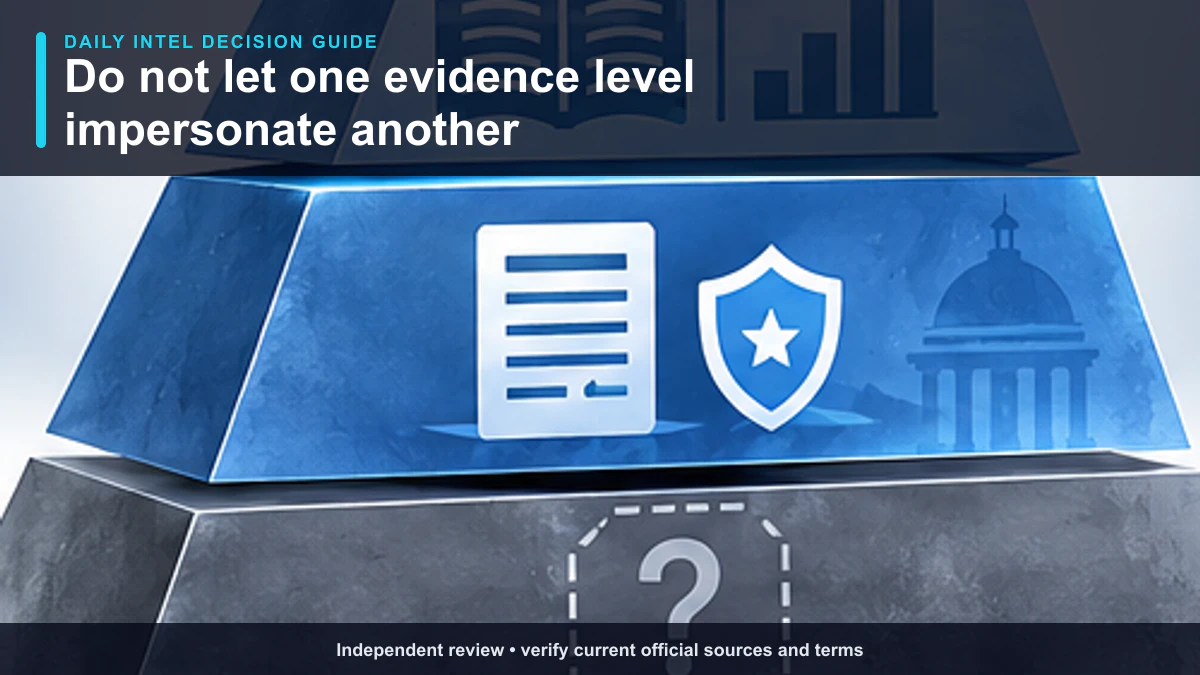
Product identity: Different types of evidence answer different questions. Keeping them separate prevents a source from being asked to prove more than it can.
For this Audien decision, the evidence ladder must keep finished-product evidence separate from ingredient, formula, dose, category, testimonial and marketing evidence. The packet documents no ingredient, formula or dose for this device offer, so none can be used as product proof.
The first level is identity. The official source identifies an Audien order page and contains the Atom One hearing-aid text. This records only a seller-controlled commercial presentation in the packet; it does not establish product performance, suitability or customer outcomes. It does not establish efficacy or safety.
The next level is seller description. The FDA-registration and OTC-clearance wording tells readers how Audien Hearing presents the product. Without the supporting regulator record, it cannot independently establish the exact regulatory status or its limits.
The independent study supplies category context. A PubMed-indexed study concerning hearing-aid use, cognition and dementia used Australian data from the ASPirin in Reducing Events in the Elderly study. Researchers emulated a target trial. A target-trial emulation applies observational data and specified analytical rules to approximate aspects of a randomized trial. It remains observational rather than an actual randomized assignment.
Eligible participants were dementia-free, had moderate hearing impairment and had not previously used hearing aids. Self-reported hearing problems were used as a proxy for moderate impairment. The study used information about new hearing-aid prescriptions and questionnaire-reported frequency of use. Cognitive assessments occurred every six months over seven years.
Across imputed data sets, the median eligible population was 2,777 and a median of 664 participants received a new hearing-aid prescription. The mean age was 75, and 48% were female. Imputation is a statistical method used to address missing data under stated assumptions.
Among survivors, estimated seven-year overall cognition was similar under the hearing-aid-prescription and no-prescription strategies. The mean difference was 0.03 standard deviations, with a 95% confidence interval from -0.14 to 0.21.
Estimated seven-year dementia risk was 5.0% under hearing-aid prescription and 7.5% without prescription. The reported risk ratio was 0.67, with a 95% confidence interval from 0.37 to 0.97. Estimated cognitive-impairment risk was 36.1% and 42.4%, respectively. The corresponding risk ratio was 0.85, with a 95% confidence interval from 0.70 to 1.00.
A risk ratio compares estimated risk between groups or strategies. A confidence interval describes the range of values compatible with the analysis under its assumptions. Neither measure removes the limitations of observational evidence.
The authors said residual confounding could explain the findings. Residual confounding means unmeasured or incompletely measured differences may have affected the observed association. They described the work as Class III evidence that hearing-aid use did not change overall cognitive scores in people aged 70 and older with moderate hearing impairment compared with nonuse. They also called for long-term randomized trials.
These findings cannot be transferred to Audien. The study did not identify Audien as the product used. The device, fitting, population, use pattern and service conditions may differ. The study therefore cannot show that Audien improves hearing, changes cognition, reduces dementia risk or produces any other individual outcome.
The next evidence level would be Audien-specific testing. None was supplied. No clinical trial, comparative study or independent product-performance result connects the current offer to a measured outcome.
Commercial provenance sits outside the performance evidence. The packet records an active affiliate contract and permission for content when captured. The program permitted United States traffic. Those facts concern the publisher relationship, not product availability, buyer eligibility, efficacy, safety or satisfaction.
The packet also records that the affiliate redirect was not tested and promotional-image rights were not verified. Those are publication issues. They are not evidence for or against product performance.
Price, add-ons and the unresolved total
Commercial check: The capture contains several price signals, but it does not produce a reliable price table for defined configurations.
exact offer snapshot: For an Audien decision, the October 2026 evidence is only a dated snapshot. Recheck shipping, consultation, guarantee and refund terms, and whether any charge is recurring, before payment.
One fragment placed “1X ATOM ONE HEARING AID” near a regular price of $149.93 and an offer amount of $99.99. The same sequence displayed “Savings $111.05.” Those figures conflict. The displayed regular price and offer amount do not produce the displayed “Savings $111.05” through straightforward subtraction.
Other fragments placed $449.78 near $219.99 and a claimed saving of $421.94; $299.85 near $169.99 and a claimed saving of $255.39; and $599.70 near $279.99 and a claimed saving of $577.38. Those claimed savings also do not equal the simple differences between their neighboring regular and offer amounts.
The surrounding capture displayed savings percentages of 26%, 37%, 46% and 48%. Separate page text said a 50% discount and an extra 10% discount had been applied. The packet does not establish which messages applied to which product, quantity or cart state. It also does not establish whether a coupon was required or which comparison price formed the baseline.
The evidence therefore supports a conflict, not a convenient single price. The amounts appeared on the captured page, but their configuration mapping and promotional arithmetic were not reliably established.
Optional costs remain unresolved. The lifetime-protection prompt used “$xxx” where its additional price would be expected. The prompt called itself a one-time offer, but that phrase does not by itself prove the payment structure or complete coverage terms. SafeTrak had an on/off control, yet its charge, default state and contractual details were not captured.
Other order-summary fields retained placeholders for donation, shipping, tax, warranty and total. No completed cart shows the final amount for a defined purchase.
The packet does not establish a subscription. It also does not prove that every possible charge is nonrecurring. No source provides a cancellation method, guarantee duration, return window, refund criteria, consultation cost or responsibility for return shipping.
Before payment, confirm all of the following:
- The exact device, model, quantity and included accessories.
- The base price and the calculation behind each discount.
- Every selected protection, delivery, donation, warranty or other option.
- Shipping, tax and the complete amount due.
- Whether any current or future charge repeats.
- Delivery estimates and available support channels.
- Return eligibility, deadline, condition requirements and shipping responsibility.
- Refund timing, exclusions and any nonrefundable amounts.
The order-page evidence was captured in October 2026. Prices and terms are a dated snapshot and may change.
Commission disclosure: Daily Intel may earn a commission if you use the link below. That commercial relationship does not change the evidence limits or standards in this review.
Inspect the current Audien offer and verify its terms
Safety, eligibility and medical boundaries
Safety boundary: The packet does not contain enough Audien-specific documentation to resolve safety or eligibility.
Audien is presented here as a hearing device. The packet also contains FDA guidance about dietary supplements. That source explains supplement oversight, medicine interactions and adverse-event reporting. Those rules and cautions do not transfer to Audien because the reviewed product is not presented as a dietary supplement.
The supplement source cannot establish anything about Audien’s device classification, clearance, safety, effectiveness, contraindications or interactions. Its proper role in this review is to demonstrate why evidence must match the product category. It is not supporting evidence for an Audien claim.
The packet supplies no Audien manual, complete label, intended-user statement, warning list or adverse-event data. It does not say whether individual anatomy, a health condition, medicine, procedure or another device affects suitability. No conclusion about those matters should be inferred from silence.
A seller-controlled checkout also cannot identify the nature or cause of an individual’s hearing difficulty. When the unresolved question concerns hearing health, symptoms, eligibility or personal suitability, an appropriately qualified health professional is a more suitable source than a commerce page.
That boundary does not mean every reader follows the same care path. It means this article cannot diagnose a condition or determine whether a device is appropriate for a particular person.
Anyone considering the offer should look for the exact device documentation, intended-use information, setup instructions, cleaning and maintenance directions, warnings, exclusions and instructions for problems. Missing or unclear material should remain an unresolved risk rather than being replaced with assumptions.
Who may continue evaluating Audien
Buyer fit: Audien may remain a candidate for a reader who wants to inspect an OTC-positioned hearing product, can identify the exact configuration and understands that the packet contains no finished-product performance proof.
That is a conditional reason to investigate, not a recommendation that the device will work.
A reader continuing responsibly would know the practical setting in which help is wanted, avoid treating the sales page as a diagnosis and be willing to stop if the documentation or terms are inadequate.
who should keep looking: Audien is a weaker fit if:
- You need an individualized assessment of your hearing.
- You cannot identify the exact device and selected configuration.
- You require independently documented Audien-specific performance evidence.
- You cannot find the intended-use information, warnings or exclusions.
- You require documented fitting, consultation or support services.
- You cannot confirm the final total and any future-charge language.
- You need clear return and refund conditions before accepting the financial risk.
Budget cannot be evaluated from one promotional amount. Shipping, selected services, replacement exposure and return restrictions can change the real commitment. The packet does not provide enough information to calculate it.
Evidence tolerance also matters. Some buyers may accept limited product evidence when price and return protection are clear. This packet does not establish that protection. Others require finished-product testing regardless of price. For them, the missing Audien-specific evidence is decisive.
Alternatives supported by this packet
Comparison: The packet contains no current sources for named competing products. A ranked brand comparison would require unsupported specifications, prices or conclusions.
It does support three alternative paths.
Waiting for documentation becomes preferable when the live page does not identify the device, intended user, safety materials, complete cost or return conditions. Waiting does not prove Audien unsuitable. It avoids treating missing information as favorable information.
A better-documented product becomes preferable when it supplies an exact model identifier, clear use information, applicable warnings, suitable product-specific evidence, transparent pricing and understandable support and return policies. The packet does not identify a named product meeting those conditions.
Professional guidance becomes preferable when the main uncertainty concerns the hearing difficulty, symptoms or individual suitability rather than the mechanics of an online purchase.
Choosing not to transact is also a valid commercial decision. This article cannot determine the health effects of that choice for an individual. It can only reject the unsupported assumption that buying Audien is the sole active option.
Daily Intel VSL Strategy We Would Test for Audien
This is an original Daily Intel video sales letter strategy. VSL means video sales letter. The packet does not show that Audien Hearing wrote, approved, tested or ran this execution. No performance claim is made for it.
Hook
The opening would begin with the incomplete decision, not with a promised hearing result.
The proposed first frame would place a product-selection checklist beside a checkout screen. The narration would explain that an accessible hearing product may be appealing, but access does not establish whether the device matches the viewer’s situation.
The script would immediately identify the verified facts. Audien has a captured order page, and Audien Hearing uses FDA-registration and OTC-clearance wording. It would then identify the unresolved facts: the packet lacks the regulator record, a finished-product performance study and complete customer terms.
This creates a reason to continue without inventing fear, scarcity or a testimonial. The viewer is promised a practical audit, not a guaranteed result.
Lead: Start With the Use Case
The next segment would ask the viewer to describe the job expected from the device. The prompts would concern the setting, frequency and practical effect of the hearing difficulty. They would not invite self-diagnosis.
The narration would explain that two questions can look similar but require different sources. “Which documented device should I consider?” is a product-comparison question. “What is causing this hearing difficulty, and what is appropriate for me?” may require individualized professional guidance.
The viewer would then receive four verification categories: product, evidence, suitability and commitment. Every later scene would return to one of those categories.
The Plain-English Mechanism: Product Verification
The product segment would show how brand identity differs from transaction identity.
The official capture identifies Audien and contains the Atom One hearing-aid text. The live checkout still needs to show which model, quantity and accessories are selected. The viewer would be instructed to record that information rather than assume every visible image or amount describes the same package.
The script would also call attention to optional controls. Lifetime protection and SafeTrak appeared in the capture, but their complete prices and terms were not established. The viewer would check whether either option is selected and what agreement governs it.
This segment gives the audience observable tasks. Either the page supplies a clear answer or the item remains unresolved.
Claim verification
The next segment would put the seller’s FDA and OTC language on screen with a clear attribution to Audien Hearing.
The narration would not attempt to interpret the missing regulator record. It would ask for the exact device identifier, the applicable record, the intended use and the accompanying limitations. The script would explain that confirming who made a claim is different from independently substantiating it.
The seller’s question about helping someone hear again would receive the same treatment. A persuasive question does not supply a measured answer. Product-specific evidence would need to identify the version tested, participant characteristics, comparison, outcomes, duration and fitting conditions.
The packet provides no such Audien trial. The script would call this an evidence limit, not a finding of failure.
Research segment
The research section would introduce the PubMed study only as category context.
It would explain that the investigators used observational data to emulate a target trial among older Australian participants with hearing impairment. The median eligible population across imputed data sets was 2,777, the median receiving a new hearing-aid prescription was 664, the mean age was 75 and 48% were female. Cognitive assessments took place every six months over seven years.
The script could accurately summarize the reported estimates, including similar overall cognition scores and the dementia and cognitive-impairment risk estimates. It would place the study’s residual-confounding warning beside those numbers.
The most prominent on-screen note would say that Audien was not the tested product. The device, fitting, population and use conditions cannot be assumed to match. No hearing, cognition or dementia-related result from that study would be attributed to Audien.
The segment would end by naming the missing evidence: a suitable Audien-specific performance study or independent comparative test.
Hypothetical checkout walkthrough
The story element would be labeled “Hypothetical checkout exercise.” It would not use a fabricated customer or claim that anyone received the product.
A reader starts with a written requirement: the situation in which assistance is wanted and the evidence standard that must be met. At the product page, the reader records the exact selected model and included items.
The reader then reviews each price. The page capture had displayed several offer amounts and conflicting savings calculations, so no promotion is accepted at face value. The reader checks the base price, discount calculation and final cart instead.
Next come optional controls. The reader identifies whether protection or SafeTrak is active, opens the applicable terms and records the charge. No assumption is made about whether an option is free, recurring or automatically selected.
Before payment, the reader checks shipping, tax, total, future-charge wording, support, returns and refunds. If every material answer is visible and acceptable, Audien can remain in the comparison. If an essential answer is absent, the reader pauses.
The pause is not presented as a product outcome. It is the output of a process that requires evidence before commitment.
Objection sequence
The first objection would concern convenience: if the product is positioned as OTC, why perform this audit? The answer is that purchase access does not establish personal suitability, device performance or customer terms.
The second objection would concern the FDA wording. The script would state that the packet confirms the seller’s words but does not contain the underlying record. The exact scope therefore remains unverified.
The third objection would point to hearing-aid research. The response would be direct: research involving hearing aids generally is not an Audien trial and cannot prove an Audien outcome.
The fourth objection would treat missing evidence as proof of failure. The script would reject that conclusion too. An evidence gap narrows the verdict; it does not demonstrate a negative result.
The fifth objection would rely on the displayed price. The response would show why one amount cannot settle value when configurations, add-ons, shipping, returns and future charges remain unclear.
The final objection would assume that a return policy removes the risk. No verified return or refund policy was supplied, so the script would instruct the viewer to read the live terms before treating the purchase as reversible.
Offer presentation
The offer segment would describe the evidence as an October 2026 snapshot. It would display the captured amounts without selecting one as the definitive Audien price.
The conflicting savings arithmetic would be shown plainly. The segment would also identify the unresolved protection price and order-summary placeholders. No discount would be repeated as a verified value proposition.
There would be no countdown, inventory claim, testimonial, guarantee or risk-free wording. The viewer would be told that the affiliate redirect was not tested and that current terms may differ from the capture.
The commercial action would therefore have one purpose: inspect the live offer. It would not imply that clicking establishes suitability, validates the seller’s claims or confirms the final price.
Low-Pressure CTA
The closing screen would repeat the four categories: product, evidence, suitability and commitment.
The viewer would proceed only after confirming the exact device, intended use, documentation, warnings, selected options, complete total, support, returns, refunds and any future charge. If those elements are absent or unacceptable, waiting, requesting documentation or choosing another path would remain reasonable.
The configured commission disclosure would appear immediately before the commercial action. It would explain that Daily Intel may earn a commission and that the relationship does not alter the review’s evidence standards.
This strategy uses informed self-qualification rather than an invented success story. Its persuasive case is that a documented decision is more useful than an unverified promise.
Frequently asked questions
Q: Is Audien a legitimate hearing aid?
A: The packet verifies an official Audien order page and the seller’s description of the product as an FDA-registered device using hearing-aid technology cleared for OTC use. It does not supply the underlying regulator record, exact device identifier or independent performance evidence needed to verify the full scope of that description.
Q: Does Audien really help people hear again?
A: The supplied evidence cannot establish that outcome. The official page presents that question, but the packet contains no Audien-specific clinical trial, comparative performance test or independently documented result. It also does not provide enough intended-use information to determine whether the offered device fits a particular hearing situation.
Q: How much does Audien cost?
A: Captured page fragments displayed $99.99, $169.99, $219.99 and $279.99, but the packet does not reliably map those amounts to defined models, quantities or selected configurations. Other fields retained placeholders for shipping, tax, warranty and optional protection. Verify the selection and complete total before paying.
Q: Is Audien a subscription?
A: The packet neither establishes a subscription nor proves that every possible charge is one-time. It shows a lifetime-protection prompt and a SafeTrak control, but their complete prices and terms were not captured. Check selected options, future-charge language, cancellation terms and the final total before submitting payment.
Q: Does hearing-aid research prove that Audien works?
A: No. The included study examined hearing-aid prescriptions and use among older Australian adults with hearing impairment. It did not identify Audien as a tested product. The packet identifies no Audien test in that study, so the study remains category context rather than Audien-specific evidence.
Q: Who should consider another path before buying Audien?
A: Keep looking if you need a hearing assessment, cannot confirm that the exact device is intended for your situation, require Audien-specific performance evidence or cannot verify the complete payment and return conditions. Professional guidance is the more appropriate path when the unresolved issue concerns your hearing rather than an online order.
Sources and evidence notes
Evidence card: Audien official order page. This seller-controlled source establishes the captured storefront path, visible order elements and Audien Hearing’s claims. It does not independently prove efficacy, safety, regulatory scope, fulfillment quality or customer outcomes.
Evidence card: PubMed record for the hearing-aid study. This primary-study record supplies category context about hearing-aid prescriptions and use among older adults with hearing impairment. It did not test Audien and cannot support an Audien hearing, cognition or dementia-related claim.
Evidence card: FDA 101: Dietary Supplements. This source addresses dietary supplements. Audien is presented as a hearing device, so the source cannot establish Audien’s regulation, safety, interactions or effectiveness. It is retained only to make that nontransfer boundary explicit.
Final Take: What Would Change the Verdict
Bottom line: Audien remains an inspect-before-buying offer on the supplied evidence. Its order path and the seller’s claims are documented. Audien-specific performance, exact regulatory scope, intended-user boundaries, device-specific safety information and complete purchase terms are not.
That record does not support a broad recommendation. It also does not support declaring the product ineffective or illegitimate. The accurate conclusion is that the packet cannot determine whether the offered device fits a particular reader or produces a dependable outcome.
what would change the verdict: The assessment would become more favorable if the exact device identifier, independently checkable regulator documentation, intended-use and warning information, suitable Audien-specific testing and coherent checkout, support, return and refund terms were produced.
It would become less favorable if the live page retained unresolved placeholders, conflicting savings language, unclear optional services or regulatory statements that could not be tied to the device in the cart.
Those conditions can be checked. Until they are, promotional wording should not be treated as a substitute for product documentation or complete transaction terms.
This article is for informational and educational purposes only. It is not medical advice. Daily Intel is independent and may earn an affiliate commission. Audien Hearing did not write, review, or control this article.
Comments(0)
No comments yet. Members, start the conversation below.
Related reads
 reviews
Sex Oil with CBD Review: Clear Lubricant Role, Limited CBD Proof
Foria documents a 56 mL coconut-oil-based intimacy product with a clear intended role, but the supplied evidence contains no clinical trial of the finished oil. Compatibility, safety boundaries, checkout terms, and the buyer’s evidence standard determine the verdict.
Read reviews
Relief Melts with CBD Review: What the Evidence Can Actually Show
Foria offers an eight-melt, internal-use CBD format for period and pelvic discomfort. The supplied evidence verifies the product and its intended routes, but it does not include a clinical trial of the finished product. This review separates seller claims, batch testing, indirect CBD research, safety guidance, and the October 2026 offer terms.
Read reviews
Party Tablets - Pink Stardust Review: Proof Gaps to Check
Pink Stardust is an adult-only, caffeinated kanna tablet sold in two-tablet packs. Ferris Wheel supplies specific use precautions, but the packet contains no finished-product clinical trial, complete readable active formula, exact caffeine amount, or fully mapped price and subscription terms.
Read