Audifort Review and Ads Breakdown: A Research-First Look
There is a moment in the Audifort Video Sales Letter that crystallizes its entire strategy in a single image: the auditory nerve rendered as a frayed electrical wire, sparking chaotically inside th…
8,226+
Videos & Ads
+50-100
Fresh Daily
$29.90
Per Month
Full Access
12.5 TB database · 72+ niches · 29 min read
There is a moment in the Audifort Video Sales Letter that crystallizes its entire strategy in a single image: the auditory nerve rendered as a frayed electrical wire, sparking chaotically inside the skull. It is a simple visual metaphor, but it does enormous persuasive work. In one stroke it pathologizes a condition that mainstream medicine has long classified as symptom-management territory, assigns it a specific, fixable mechanical cause, and positions the product as the electrician who can finally rewire the system. For the millions of Americans who have been told by a physician that there is "nothing that really works" for tinnitus, that image functions less as metaphor and more as a revelation. It is the kind of opening that stops a scroll.
This piece is an analytical study of that sales letter and the product it promotes, Audifort, a liquid drop supplement marketed as the first individually tailored solution for tinnitus. The analysis covers the product's stated mechanism and ingredient science, the rhetorical architecture of the pitch, the authority signals the letter deploys and how credible they actually are, and the offer structure designed to convert a skeptical buyer who has already failed with prior treatments. The goal is not to endorse or condemn the product, but to give a reader who is actively researching it the most substantive, evidence-grounded reading available, one that neither flatters the marketing nor dismisses it reflexively.
What makes this VSL worth studying closely is not that it is unusual, but that it is unusually sophisticated. It synthesizes personal narrative, institutional science references, conspiracy framing, exotic cultural proof, and tiered pricing mechanics into a single continuous experience that runs well over thirty minutes. Every structural decision, the order of revelations, the placement of the mother's story, the moment the price is finally named, reflects deliberate copywriting craft. Understanding why each choice was made illuminates both the product and the broader market it is competing in.
The central question this study investigates is this: does the scientific mechanism at the heart of Audifort's pitch. The concept of a repairable "neural junction" between ear and brain. Correspond to real, published science, and do the ingredients chosen to address it carry genuine evidentiary support? The answer, as is usually the case with sophisticated supplement marketing, is more nuanced than either a blanket yes or a blanket no.
What Is Audifort?
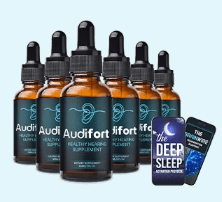
Audifort is a dietary supplement delivered in liquid drop form, marketed primarily to adults experiencing chronic tinnitus; the perception of ringing, buzzing, hissing, or whooshing sounds in the absence of an external acoustic source. The product is positioned in the health-and-wellness category at the intersection of auditory health and cognitive support, a subcategory that has expanded significantly as the U.S. population ages and awareness of the tinnitus-dementia link grows in popular media. The liquid drop format is a meaningful differentiator from the capsule-based supplements that dominate this space: the VSL claims faster absorption and, more strikingly, individual personalization, buyers complete a health questionnaire before their order is fulfilled, and the formula is theoretically calibrated to their age, weight, symptom duration, and the specific type of sound they experience.
The product contains thirteen plant-based extracts, with three highlighted by name in the VSL: a proprietary form called Japanese Alpine Ginkgo Biloba, a water-fermented variant of N-Acetylcysteine branded as Hydro Pure NAC, and Lion's Mane mushroom. The remaining ten ingredients are not disclosed in the transcript. The product is manufactured in the United States in what the VSL describes as an FDA-registered, GMP-certified facility, is non-GMO, and is presented as free of stimulants, toxins, and addictive compounds. It is sold exclusively through its own website, the letter explicitly warns buyers that any Audifort found on Amazon, Walmart, or Costco is counterfeit.
The stated target user is someone who has suffered from tinnitus for an extended period, has already exhausted standard options (hearing aids, sound machines, medication, therapy), and lives in fear of the condition progressing into more serious neurological territory. The pitch leans heavily on an older demographic, references to grandchildren, memory games, cancelled cruises, and the terrifying experience of cognitive confusion in public spaces all signal that the primary buyer is likely in their sixties or seventies, financially able to purchase a multi-bottle supplement package, and emotionally primed by years of failed treatments to believe that the mainstream medical system has failed them.
The Problem It Targets
Tinnitus is genuinely prevalent and genuinely undertreated. The American Tinnitus Association estimates that approximately 15 percent of the general population, more than 50 million Americans, experience some form of tinnitus, with roughly two million experiencing it as debilitating. The condition disproportionately affects older adults and those with a history of noise exposure, but it is not confined to any demographic. Critically, the medical consensus on tinnitus treatment remains frustratingly limited: the American Academy of Otolaryngology's clinical practice guidelines acknowledge that no pharmacological treatment has been approved by the FDA specifically for tinnitus, and the standard of care centers on management strategies, cognitive behavioral therapy, sound therapy, and tinnitus retraining therapy, rather than cure. This is not a secret the VSL is uncovering; it is documented medical reality, and it creates genuine, sustained demand for anything that promises to do better.
The Audifort VSL frames this established medical gap not as an honest limitation of current science but as deliberate suppression. The claim that "99.9% of hearing-related drugs fail in clinical trials". Attributed to a "European Commission of Health" study. Is deployed as evidence of pharmaceutical conspiracy rather than the routine, well-documented difficulty of treating neurological conditions pharmacologically. This framing is rhetorically powerful because it is parasitic on a real fact (drug failure rates in central nervous system conditions are exceptionally high, often above 90 percent in Phase II trials, as documented in journals including Nature Reviews Drug Discovery) while inserting a conspiratorial explanation that the actual data does not support. High drug failure rates are a feature of scientific rigor, not a cover-up.
The VSL also invokes the relationship between tinnitus and cognitive decline, a connection that does have scientific grounding. Research published in JAMA Otolaryngology-Head & Neck Surgery and subsequent studies have found associations between chronic tinnitus and elevated rates of anxiety, depression, and in some populations, cognitive decline. The claim that tinnitus increases "neurological complication risk by 62%" is specific enough to suggest a real study, but the source is not named clearly enough to verify. What the VSL does with this genuine association is characteristic of the category: it extrapolates from a statistical correlation to a mechanistic, causal, and reversible process; a leap the underlying epidemiology does not authorize.
The emotional framing of the problem is where the VSL demonstrates its most sophisticated craft. Rather than listing symptoms abstractly, it situates tinnitus inside a specific, humiliating social incident: Andrew's mother, confused by the noise in her head during a traffic stop, steps out of her car with her hands raised and nearly gets arrested. The scene is designed to make the condition viscerally real in a way that no symptom checklist can achieve. Whether or not the incident is autobiographical, its function is to convert the audience's private suffering into a shared, witnessed narrative, the precondition for any product story that works.
Curious how other VSLs in this niche structure their pitch? Keep reading, Section 7 breaks down the psychology behind every claim above.
How Audifort Works
The core mechanism claim in the Audifort VSL is built around what the letter calls the "neural junction", described as a microscopic nerve fiber, finer than a human hair, that spirals from the inner ear to the brain and serves as the primary carrier of sound signals. According to the VSL, tinnitus is not an ear problem or a simple nerve problem but a signal-transmission problem at this specific junction: when the fiber is damaged or misfiring, it sends scrambled electrical signals to the brain, which the brain interprets as sound even in silence. The argument is supported by reference to a 2015 experiment in which severing the auditory nerve in tinnitus patients actually worsened their symptoms, proof, the VSL claims, that the cause is not in the nerve itself but in the junction's signal quality.
This conceptual frame maps onto real neuroscientific territory, and that is precisely what makes it persuasive. There is genuine, published research into what audiologists and neuroscientists call "hidden hearing loss" or cochlear synaptopathy, a condition in which synaptic connections between inner hair cells and auditory nerve fibers are damaged by noise exposure or aging without any measurable change in standard audiometric thresholds. Work by researchers including Charles Liberman at Harvard Medical School and Sharon Kujawa at Massachusetts Eye and Ear (published in Journal of Neuroscience, 2009) has documented that these synaptic losses are widespread and may contribute to tinnitus and difficulty processing speech in noise. The VSL's "neural junction" concept is, at minimum, a recognizable popularization of this research area, even if the specific terminology is proprietary rather than standard.
The problem with the mechanism claim is the gap between correlation and cure. Identifying a plausible biological locus for tinnitus, the cochlear synapse, is genuinely useful science. Claiming that a specific blend of oral supplements can regenerate those synaptic connections in adult humans is a substantially more ambitious assertion, and one for which the evidence is considerably thinner. Neuroregeneration in the peripheral auditory system is an active area of research, with promising early results from compounds like NT-3 (neurotrophin-3) in animal models, but these are investigational compounds delivered via localized cochlear injection, not dietary supplements consumed as oral drops. The biological pathway from an orally ingested plant extract to a repaired auditory synapse involves absorption, blood-brain barrier crossing, cochlear penetration, and synaptic regeneration. Each step of which faces its own pharmacokinetic challenges. The VSL does not address any of these steps; it simply asserts that the ingredients "target the neural junction" and presents testimonials as proof of mechanism.
It is worth distinguishing carefully here: some of the individual ingredients have real, peer-reviewed evidence for supporting circulatory or neurological health in general. The claim that those effects translate specifically and reliably into tinnitus resolution is where the science becomes speculative. A responsible reader should hold those two facts simultaneously rather than collapsing them into either full belief or full dismissal.
Key Ingredients and Components
The VSL names three primary active ingredients and gestures at ten more without identifying them. What is publicly known about the three named compounds is summarized below.
Japanese Alpine Ginkgo Biloba: Ginkgo biloba is one of the most studied herbal compounds in the world, with a long history of use for circulatory support and cognitive function. The VSL claims a high-altitude Japanese variety has superior potency and specifically improves blood flow from the inner ear to the brain. There is some published research on ginkgo and tinnitus. A Cochrane systematic review by Drew and Davies (2001) examined multiple trials and found the evidence inconclusive, and a large trial published in Family Practice (2001) by Drew and colleagues found ginkgo no more effective than placebo for tinnitus specifically. More recent work has been similarly mixed. The mechanism claimed; improved cochlear microcirculation, is biologically plausible, but the clinical outcome data for tinnitus is not strong. The VSL's citation of "neurologist Hayaan Wan" and "Dr. Iyuner" could not be independently verified from the transcript details provided.
Hydro Pure NAC (N-Acetylcysteine): NAC is a precursor to glutathione, the body's primary endogenous antioxidant, and has well-documented protective effects against noise-induced hearing loss in animal models and some human studies. Research including a trial by Doosti and colleagues published in Noise & Health (2013) found NAC reduced temporary threshold shifts in noise-exposed workers. The VSL's claim of a "water-based fermentation method" creating superior bioavailability is proprietary and not independently verifiable, but the underlying rationale for including NAC in an auditory health formula, oxidative stress reduction at the cochlear level, is scientifically grounded. The cited 2023 study by "Eric A. Walker" in the Journal of Otology and Neurotology could not be verified from transcript details alone.
Lion's Mane mushroom (Hericium erinaceus): Lion's Mane contains compounds called hericenones and erinacines that have demonstrated the ability to stimulate nerve growth factor (NGF) production in preclinical (cell culture and rodent) studies. A small double-blind trial by Mori and colleagues published in Phytotherapy Research (2009) found cognitive improvements in older adults with mild cognitive impairment. The application to tinnitus and auditory nerve regeneration is extrapolated rather than directly studied, the VSL's claim of a "double-blind placebo-controlled study in adults aged 60-80 experiencing tinnitus" using Lion's Mane could not be confirmed in the publicly available literature from the transcript's description alone.
Hooks and Ad Angles
The VSL opens with a line that functions as a textbook pattern interrupt: "This is the difference between healthy hearing and tinnitus." The sentence is declarative and promises an immediate revelation, but its real function is to activate a visual frame, the frayed wire, before the viewer has had time to construct skeptical defenses. In copywriting taxonomy, this is a Category Entry Point hook: it meets the buyer exactly at the moment of symptom awareness and redirects their existing mental model ("tinnitus is an ear problem") toward the seller's proprietary frame ("tinnitus is a wiring problem"). Eugene Schwartz, in Breakthrough Advertising, described this as a market sophistication stage 4 or 5 move, by 2024, the tinnitus supplement market is saturated with generic "support your hearing" messaging, and a buyer who has seen dozens of those ads is immune to direct benefit claims. The only approach that cuts through is a new mechanism, and the neural junction is precisely that: a proprietary label for a real concept, engineered to make every prior treatment seem like it was addressing the wrong thing.
The letter's secondary hooks compound this opening architecture. The story of the Japanese elder Masaru Tanaka introduces what persuasion researchers call an identity aspirational anchor. A living proof that the outcome promised is not only possible but has been quietly achieved by people who possess information the mainstream does not. The quiz about neural junction deterioration deploys a commitment and consistency mechanism (Cialdini, 2001): once a viewer has mentally answered "yes" to three or four of the seven questions, they have self-diagnosed a problem, which psychologically commits them to seeking a solution. The Big Pharma suppression frame, discussed more fully in the psychological triggers section, functions as a false enemy that explains all prior failures without implicating the buyer's intelligence.
The secondary hooks observed in the VSL:
- "Why do completely deaf people still suffer from tinnitus?". Curiosity gap combined with authority-based mystery
- "Tinnitus is literally burning out your brain"; visceral fear escalation
- "99.9% of hearing drugs fail before they reach shelves", contrarian authority claim
- "An 88-year-old Japanese man out-hearing 30-year-olds", exotic proof of concept
- "She nearly got arrested because of her tinnitus", narrative shock hook
Ad headline variations a media buyer could test on Meta or YouTube:
- "Doctors Have No Cure for Tinnitus. A Neurosurgeon's Private Research Does."
- "The Real Reason Your Ears Won't Stop Ringing (It's Not What You Think)"
- "Japanese Elder, 88, Still Wins Hearing Tests. Scientists Finally Know Why."
- "She Tried Everything for 10 Years. One Neural Discovery Changed It All."
- "Warning: Big Pharma Is Trying to Remove This Tinnitus Video"
Psychological Triggers and Persuasion Tactics
The persuasive architecture of the Audifort VSL is not a simple stack of individual techniques; it is a sequenced, interlocking system in which each psychological mechanism reinforces the next. The letter begins by establishing fear (tinnitus leads to dementia), then relieves that fear partially with the discovery narrative (there is a real cause and a real fix), then rebuilds urgency through scarcity and conspiracy, and only then introduces the product and price. This arc mirrors the structure Cialdini described in Influence and that Russell Brunson has codified as the "epiphany bridge", the buyer must experience their own cognitive shift before they will act, and the VSL's job is to engineer that shift. What distinguishes this letter from average-quality supplement VSLs is the density and specificity of the authority signals woven through each stage of the arc, which function as continuous permission-givers allowing the buyer to justify belief at each step.
The stacking of loss aversion, social proof, and scarcity in the final third of the letter is particularly calculated. By the time the price is revealed, the viewer has been told that 59,875 people have already solved the problem the viewer is still suffering from, that the ingredients are nearly impossible to source and may be unavailable for months after sell-out, and that the video itself may be removed by corporate interests at any moment. Each of these signals applies pressure from a different cognitive direction, social proof says "others have already decided"; scarcity says "the window is closing"; censorship threat says "this is the last chance to access the truth." Together, they create what behavioral economists would recognize as a manufactured scarcity environment designed to suppress deliberative thinking and accelerate impulsive commitment.
Specific tactics identified:
- Loss aversion escalation (Kahneman & Tversky prospect theory): Progressive symptom escalation from ringing → brain fog → dementia → Parkinson's makes the cost of inaction feel existential. The 62% increased neurological risk statistic lands at the peak of this sequence.
- False enemy framing (Cialdini's in-group/out-group principle): Big Pharma as villain simultaneously explains all prior treatment failures, builds tribal loyalty to Audifort as the suppressed truth, and positions the buyer as a sophisticated insider who has "finally seen through" the system.
- Authority stacking via borrowed institutional credibility: Harvard, University of Iowa, Massachusetts Eye and Ear, and Nature Neuroscience are invoked in close succession. None are claimed to endorse Audifort specifically, but proximity to those names transfers credibility through cognitive association.
- Commitment and consistency via self-diagnostic quiz (Cialdini, 2001; Festinger's cognitive dissonance theory): The seven-question quiz requires the viewer to mentally affirm their own symptoms, creating a self-diagnosis that makes the product feel personally indicated rather than generically marketed.
- Social proof via non-round numbers: The figure of 59,875 (not 60,000) implies precise record-keeping and documented case tracking, lending the social proof a scientific veneer it would lack if expressed as a round estimate.
- Price anchoring via extreme contrast (Ariely's predictably irrational anchoring research): The $900 → $700 → $59 sequence makes the final price feel not just affordable but almost suspiciously cheap, activating the endowment effect (Thaler, 1980), the buyer feels they are claiming something valuable before it disappears.
- Narrative identity transfer via the mother's story: By making Andrew's mother, not a statistics-bearing study subject but a fully realized character with quirks, cancelled cruises, and a favorite song. The product's primary proof case, the letter gives every viewer a surrogate through whom to imagine their own recovery.
Want to see how these tactics compare across 50+ VSLs? That's exactly what Intel Services is built to show you.
Scientific and Authority Signals
The Audifort VSL deploys authority signals at three distinct levels, and it is worth separating them analytically because they carry very different degrees of legitimate weight. The first level. Real institutions cited in real contexts; includes Harvard, the University of Iowa, the University of Auckland, and Massachusetts Eye and Ear. Each of these institutions does conduct genuine tinnitus and auditory neuroscience research, and the field of cochlear synaptopathy is a real and active area of study. The VSL does not claim these institutions endorse Audifort; it claims they are "sounding the alarm" about tinnitus and neural damage. That is a defensible reading of the public research record, even if it selectively amplifies findings that serve the product narrative.
The second level is where credibility becomes significantly harder to assess. Named researchers, "neurologist Hayaan Wan," "Dr. Iyuner" with 547 participants, and "Eric A. Walker" in the Journal of Otology and Neurotology (2023), are cited with enough specificity to appear verifiable but cannot be confirmed from the transcript's level of detail. The "2019 study from the Lauer-Tinnitus Research Center" and the "European Commission of Health" study on drug failure rates are similarly unverifiable as described. The Lauer Tinnitus Research Center is a real entity affiliated with the University of Michigan, which does lend partial plausibility; the specific 2019 study cited cannot be confirmed. The "European Commission of Health" is not a standard institutional name, the EU body is typically the European Commission's Directorate-General for Health and Food Safety, which raises questions about whether the cited organization exists as described.
The third level concerns the product's central named authority figure, Dr. Richard Terry, described as one of America's top neurosurgeons who was personally afflicted by tinnitus, participated anonymously in the key research study, and formulated the original nutrient protocol. No independent verification of this individual is possible from the VSL alone. The detail that he "wasn't listed as a lead doctor" because he was there as a patient conveniently explains the absence of a verifiable publication record. This is a common structure in supplement VSLs: a highly credentialed but privately anonymous expert whose inaccessibility cannot be used to challenge the claims attributed to them. Whether Dr. Terry is a real person, a composite, or a narrative device, the persuasive function is identical: he provides insider credibility that launders the product's claims through an authority the buyer cannot interrogate.
The overall authority architecture of this VSL is best described as legitimate-fringe blended, real institutions and real research areas are invoked accurately at the category level, while specific claims about the product's mechanism and efficacy are attributed to sources that cannot be independently verified. This is sophisticated because it passes casual scrutiny (the institutions are real) while evading rigorous scrutiny (the specific studies cannot be confirmed). Readers conducting due diligence should treat named-but-unverifiable studies as claims requiring independent verification before being accepted as evidence.
The Offer, Pricing, and Risk Reversal
The Audifort offer is structured around a classic price anchor cascade: Dr. Richard originally suggested $900 per bottle; research partners considered $700 fair; the actual price is $59 per bottle in the six-bottle package and $79 for a single bottle. The anchors serve a dual purpose, they establish perceived value and they make the actual price seem not merely affordable but almost irrationally low. The comparison to $5,000 in annual conventional treatment costs (hearing specialists at $600/visit, hearing aids at $3,000, therapy at $200/hour) is the more significant anchor in practice, because it benchmarks against costs the target buyer is likely to have actually incurred or considered. Whether those figures represent a realistic annual spend for the median tinnitus sufferer is debatable, most patients do not see specialists at that frequency. But they are not invented from nothing, and they are more emotionally credible than the $900 bottle price, which no supplement buyer would genuinely expect to pay.
The bonus structure is worth noting for its precision. The two free gifts. The Deep Sleep Activation Protocol (valued at $420) and the Brainwire Regeneration Blueprint (valued at $390); are priced to produce a combined "free value" of $810, deliberately exceeding the cost of a six-bottle package by a wide margin. This is a standard value stacking technique that makes the bonus items appear to cost more than the product itself, reversing the typical buyer logic that they are paying for extras. The recovery program (access to Andrew's team, nominally $200/hour) functions as the highest-status bonus because it implies a personal relationship rather than a digital download.
The 90-day money-back guarantee is the offer's most credible component. A genuine no-questions-asked refund policy on a consumable product is meaningful risk reversal, and 90 days is longer than the industry standard of 30 or 60. Whether the guarantee is honored in practice is a separate question that this analysis cannot answer from the VSL alone, but its structural function, transforming a high-uncertainty purchase into a low-downside trial, is real and significant. Buyers who are genuinely skeptical and willing to document their experience face relatively low financial risk at the $59-per-bottle price point, provided the refund process is as frictionless as promised.
Who This Is For (and Who It Isn't)
The ideal Audifort buyer, as constructed by this VSL, is a person in their sixties or seventies who has experienced chronic tinnitus for at least several months, has already spent money on mainstream interventions without meaningful relief, and has developed a generalized distrust of the pharmaceutical system, whether from personal experience, media consumption, or both. They are likely health-conscious (not opposed to supplements), digitally capable enough to watch a long-form video and complete an online checkout, and emotionally activated by stories of family members suffering because the medical system failed them. They are not looking for a clinical trial; they are looking for permission to believe that relief is possible. The VSL gives them that permission through narrative rather than through controlled evidence, which is precisely the right tool for this state of mind.
The product may also resonate with a slightly younger cohort, adults in their forties and fifties with noise-induced tinnitus from occupational or recreational exposure, for whom the cognitive decline messaging carries a different but equally potent fear profile: not "am I becoming like my parents?" but "am I losing my edge?"
Readers who should approach with greater caution include those seeking a pharmacologically validated treatment with controlled trial evidence at the product level. The individual ingredients in Audifort have varying degrees of independent research support, but the product as formulated has not been tested in published clinical trials. Anyone with active cardiovascular conditions, taking blood thinners (ginkgo biloba has anticoagulant properties that can interact with warfarin and similar drugs), or managing serious neurological diagnoses should consult a physician before use, not as a legal disclaimer, but as a genuinely practical precaution. The VSL itself acknowledges this in the FAQ, which is a point in its favor. Finally, buyers who experience tinnitus as a symptom of an undiagnosed underlying condition, acoustic neuroma, Meniere's disease, vascular anomalies. Need a diagnostic evaluation before any supplement intervention, because masking or reducing the tinnitus signal without identifying its root cause can delay necessary medical treatment.
If you found this breakdown useful, Intel Services has similar deep-dive analyses across dozens of health and wellness VSLs. Keep reading to find the one most relevant to your research.
Frequently Asked Questions
Q: Is Audifort a scam?
A: Audifort is a commercially sold supplement with real ingredients, a stated manufacturing process, and a refund guarantee. None of which define a scam in the strict sense. The marketing makes claims about repairing the "neural junction" that go significantly beyond what published clinical evidence for the named ingredients supports. Buyers should evaluate those claims critically rather than taking them at face value, but the product is not obviously fraudulent in the way a counterfeit or entirely fictitious product would be.
Q: Does Audifort really work for tinnitus?
A: The VSL cites nearly 60,000 success stories and multiple testimonials. Independent clinical trial data specific to the Audifort formulation is not publicly available, which makes it impossible to assess efficacy through the standard scientific lens. Some of its ingredients; particularly NAC and ginkgo biloba, have individual research support for auditory and neurological health. Whether they work in the specific combination and dosage formulated by Audifort, for the specific population of chronic tinnitus sufferers, remains an open question.
Q: What are the main ingredients in Audifort?
A: The VSL identifies three primary ingredients: Japanese Alpine Ginkgo Biloba, Hydro Pure NAC (a water-fermented form of N-Acetylcysteine), and Lion's Mane mushroom. The product also contains ten additional plant extracts that are not named in the marketing materials. A full supplement facts panel would be needed to assess the complete formulation.
Q: Are there any side effects from taking Audifort?
A: The VSL states that most users experience no side effects, and that the formula contains no stimulants, toxins, or addictive substances. Ginkgo biloba carries a clinically documented interaction risk with anticoagulant medications and can occasionally cause headaches or gastrointestinal discomfort. NAC at high doses has been associated with nausea in some individuals. Anyone taking prescription blood thinners or managing a chronic condition should review the ingredient list with their doctor before starting.
Q: Is Audifort safe to take with other medications?
A: The VSL recommends showing the ingredient list to a doctor if you take medications or have a medical condition, reasonable advice. The most clinically relevant concern is ginkgo biloba's antiplatelet activity, which can potentiate the effects of warfarin, aspirin, and other blood thinners. This is not a theoretical risk; it is documented in pharmacological literature. Independent medical review is advisable for anyone in this category.
Q: How long does it take for Audifort to work?
A: According to the VSL, some users notice changes in the first one to two weeks, while most experience significant reduction in tinnitus within six to eight weeks. The letter recommends a minimum of three bottles (roughly 75 days) for lasting results, and six bottles for complete recovery and long-term protection. These timelines are presented as clinical guidelines but are based on the company's own internal data rather than published trial results.
Q: What is the neural junction and does fixing it actually stop tinnitus?
A: The "neural junction" as described in the VSL maps onto the concept of cochlear synapses, the connections between inner hair cells and auditory nerve fibers, which are an active area of real research into noise-induced and age-related hearing loss. Damage to these synapses is genuine and documented. Whether oral supplements can regenerate these synaptic connections in adult humans has not been established in clinical trials. The mechanism is biologically plausible in outline; the supplement-as-cure claim is an extrapolation that current evidence does not firmly support.
Q: What happens if Audifort doesn't work? Can I get a refund?
A: The VSL offers a 90-day, no-questions-asked, full money-back guarantee, including on used bottles. If honored as described, this represents a meaningful low-risk trial window. Buyers should retain their order confirmation and any correspondence, and contact customer support through the official channel listed on the purchase page within the 90-day window if results are unsatisfactory.
Final Take
The Audifort VSL represents a mature, well-engineered entry in the tinnitus supplement category, a market that has grown substantially as the baby boomer cohort ages into the demographic window where tinnitus, hearing loss, and cognitive anxiety converge. What distinguishes this letter from the median supplement pitch is the sophistication of its scientific framing: it correctly identifies a real and underappreciated mechanism in auditory neuroscience (cochlear synaptopathy), names that mechanism with a proprietary term (neural junction) that sounds clinical enough to confer authority, and uses that term as the anchor for every product claim that follows. The result is a letter that feels more like a medical briefing than a sales pitch, which is, of course, the point.
The weakest elements of the VSL are its authority claims at the specific level. Named researchers and studies that cannot be independently verified are a meaningful credibility liability for any analytically inclined buyer. The "Dr. Richard Terry" narrative. A top neurosurgeon who anonymously participated in a landmark study and formulated the protocol. Is structurally convenient in ways that make rigorous verification impossible, which should give any careful reader pause. The conspiracy framing around Big Pharma is emotionally effective and not without basis in real structural problems in pharmaceutical economics, but it is used here in a way that pre-emptively discredits any critical response to the product, which is a persuasion technique rather than an epistemic argument.
The ingredients themselves occupy a more defensible middle ground. NAC and Lion's Mane in particular have genuine and growing research profiles in neurological and auditory health contexts, even if the direct evidence for tinnitus resolution in humans remains limited. The liquid drop format and personalization questionnaire are genuine product differentiators, even if the functional significance of micro-dosage personalization for plant extracts has not been clinically validated. A reader who purchases Audifort is not buying snake oil in any obvious sense; they are buying a supplement formulation with plausible biological rationale, sold through a pitch that significantly overstates the certainty of its outcomes.
For a reader actively researching this product before purchasing: the 90-day guarantee is real structural protection, the ingredients are not dangerous for most healthy adults, and the price per day at the six-bottle tier is genuinely modest. The decision to buy or pass should hinge less on the marketing story, which is elaborate and professionally constructed but not independently verifiable, and more on a realistic assessment of how much weight you give to plausible-mechanism-plus-testimonials in the absence of product-level clinical trial data. That is an honest summary of what this product is: promising in mechanism, sincere in production values, and ahead of its evidence base in its outcome claims.
This breakdown is part of Intel Services, our ongoing library of VSL and ad-copy analyses. If you are researching similar products in the hearing health, cognitive support, or longevity supplement space, keep reading.
Disclaimer: This article is for research and educational purposes only. It is not medical, legal, or financial advice, and it is not affiliated with the product or its makers. Always consult a qualified professional before making health or financial decisions.
Source-backed reader context
Additional Reviews & Reported Experiences
These statements were presented in the product's sales transcript. Daily Intel did not independently verify the speakers, purchase status, or reported outcomes, and the statements are not used in Product aggregateRating.
Andrew's mother
Date not stated
ringing stopped, energy restored, hearing felt 20 years younger
Anonymous male voice 1
Date not stated
worked around loud equipment for years, had tinnitus 10+ years, tried everything — now says 'for the first time in decades, silence
Anonymous male voice 2
Date not stated
called it the hardest battle of his life, mentally and physically draining — now gone
Anonymous user
Date not stated
used to wake up every night from ringing, now sleeps through the night after learning about the neural junction
Audifort customer
Date not stated
'tinnitus used to control my life, with Audifort I got a fresh start
Audifort customer
Date not stated
'the ringing that used to drive me crazy has faded away and my ears finally feel normal
Comments(0)
No comments yet. Members, start the conversation below.
Related reads
 reviews
ARMRA Colostrum Review: Evidence, Dose Gaps, Price, and Verdict
ARMRA’s 120-serving colostrum powder comes with notable manufacturer-reported survey percentages. However, the undisclosed amount per serving and a materially different ingredient trial leave the finished product’s highlighted outcomes unproven.
Read reviews
Olly Goodbye Stress Review: Label Claims vs. Evidence
OLLY Goodbye Stress combines GABA, L-theanine, and lemon balm extract in a Berry Verbena gummy aimed at occasional stress, not sleep. Here's what the label discloses, what a real L-theanine trial found, and exactly where the evidence stops.
Read reviews
Kaged Pre-Kaged Sport Review: Does the Citrulline Study Fit?
Kaged Pre-Kaged Sport provides 3.5 grams of fermented L-citrulline in each 13-gram scoop. The supplied trial tested a higher dose of isolated L-citrulline and found no performance benefit, so it cannot prove whether this finished formula works.
Read